In heavy-gauge (thick-sheet) thermoforming, choosing the right tooling concept is one of the most critical decisions in the product development phase. Because thick plastic sheets (typically ranging from 3mm to 12mm or more) behave differently under heat and stress than thin films, the choice of mold directly impacts wall thickness distribution, structural strength, dimensional accuracy, and overall part cost.
When designing your plastic components, understanding the core differences between a Male Mold (Positive Mold) and a Female Mold (Negative Mold)—as well as advanced variations like High-Pressure Forming and Snap-Back Moulding—is essential for optimizing your manufacturing results.
1. Female Molds (Concave)
In a female mold setup, the heated plastic sheet is stretched and drawn into a hollow cavity.
- How It Works: The outer surface of the heated plastic first makes contact with the edges of the mold cavity. As vacuum or pressure is applied, the sheet is forced outward against the interior walls of the mold.
- Key Characteristic: The outer dimensions and exterior surface finish of the part are extremely precise. Any textures, matte finishes, or fine details engraved on the inside of the mold will be perfectly transferred to the outside of the product.
- Wall Thickness Behavior: Because the plastic stretches outward to meet the mold walls, the material at the corners and the bottom tends to thin out, while the top rim retains more thickness.
- Typical Applications:
- Large housings and enclosures (e.g., medical equipment covers, machine guards)
- Automotive parts (dashboards, interior trim)
- Luggage shells, pallets, and large trays where the outer appearance and exact exterior dimensions are critical.
2. Male Molds (Convex)
In a male mold setup, the heated plastic sheet is draped over a raised, plug-like form.
- How It Works: The center of the heated sheet touches the top of the male mold first. The material is then draped downward over the sides of the mold using vacuum assistance.
- Key Characteristic: The internal dimensions and inner fit of the part are extremely precise. If your thick-sheet part needs to fit tightly over a metal frame, internal structure, or another component, a male mold is often preferred.
- Wall Thickness Behavior: The material at the top of the mold (which touches first) cools and thickens the least amount of stretch, whereas the material stretching down the vertical walls experiences more thinning.
- Typical Applications:
- Structural components that require a precise inner cavity fit
- Deep-draw parts where internal clearance is the primary design requirement
3. Advanced Thick-Sheet Techniques: High-Pressure & Snap-Back
To overcome the natural thinning limitations of standard vacuum forming, modern heavy-gauge thermoforming utilizes advanced techniques:
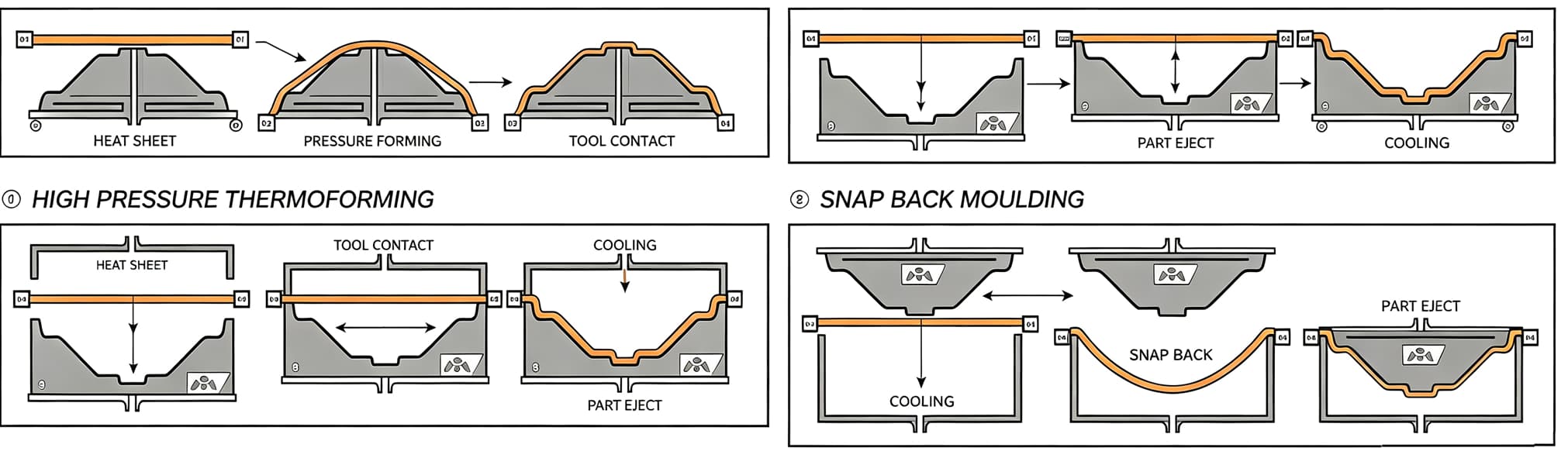
- High-Pressure Thermoforming: By combining a mold with a pressure box, compressed air forces the thick heated sheet tightly against the mold contours. This captures sharp radii, crisp corners, and logos with an injection-molding-like finish—ideal for high-end plastic enclosures.
- Snap-Back Moulding: In this method, the heated sheet is first pre-stretched into a "bubble" using air or vacuum. Then, a male mold is plunged into the bubble, and a vacuum is applied. This technique allows for a much more even distribution of material thickness, making it ideal for deep, complex heavy-gauge parts.
Summary: Which Tooling Should You Choose?
- Choose a Female Mold if your priority is superior exterior aesthetics, exact outer dimensions, and textured surface finishes.
- Choose a Male Mold if your priority is precise internal dimensions and a snug fit over internal structures.
Looking to bring a heavy-gauge plastic part from concept to reality? Contact our engineering team today to discuss the ideal tooling strategy and material selection for your next project!